
So the last two sessions have been the most useful ones yet, and almost none of that is because of the riding. It’s because I finally sat down and went through every single event the tool found, one clip at a time, and told it what actually happened — and it turns out I disagree with it rather a lot.
The riding first, briefly. Tuesday evening was on the Air cable and produced the longest air I’ve measured, 0.82 seconds, along with eleven over half a second, which is more than any session I’ve recorded. It also produced the hardest landing I’ve measured, 13.4G, on my first attempt at the kicker switch, which ended in the water. Sunday was the Tech cable and was almost entirely the box — thirteen trips over it and eight ollie 180s from normal to switch.
Now the interesting bit. The tool logged twenty-three airs on the Tech session, and when I annotated all thirty-two events I found that eleven of those “airs” were me riding onto the box, and eight were ollie 180s. Which is fine as far as it goes, except that the same manoeuvre — by my own description, the same thing done thirteen times — was landing on both sides of the line. Eleven of my box entries counted as airs and two counted as impacts. That’s not a threshold being slightly off, that’s a measurement that doesn’t know what it’s measuring.
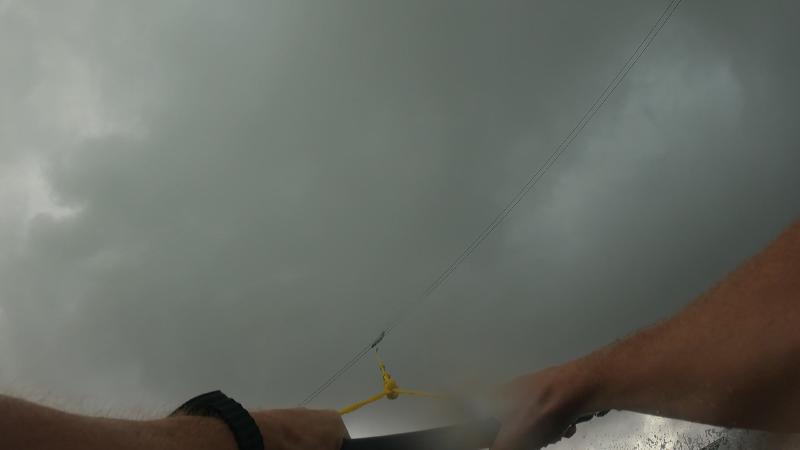
I was fairly sure this was fixable. The tool decides something is an air by looking for a period where the accelerometer drops below a threshold, and I assumed the threshold was just a bit too strict for the short hops onto the box. So we went looking, and the raw signal absolutely does drop — down to under 2 m/s² on some of them, which is properly airborne — but there’s a 0.2 second smoothing window applied to reject the noise of the board chattering across the water, and these jumps only last 0.06 to 0.16 seconds. The smoothing averages them away. The tool cannot see an air shorter than its own smoothing window, which is a slightly humbling thing to discover about a thing you built.
And it can’t be fixed by turning the dial. To catch all six of the ones it missed, the airborne threshold has to go up to 10 m/s², which is above the resting value of gravity — so “airborne” would mean any unweighting at all, every bump and every edge transition. The two sessions I’d checked by eye go from 29 airs to 53 and from 18 to 35. It catches my box entries by calling everything an air. So that one’s written up as tried and abandoned, and if I ever want the 180s measured properly it’ll need the rotation data rather than the accelerometer.
The other thing that came out of this was a genuine bug, and I like this one. On Sunday I had a bad landing coming off the box, tried to ride it out for three or four seconds, and then caught a toe edge and went in. The tool recorded it as a landing I rode away from. It works out falls by looking at GPS speed after an impact and taking the average over the following ten seconds — and those three or four seconds of me riding it out dragged the average up to 8.25 kph against a threshold of 8.0. It cleared the line by a quarter of a kilometre an hour. An average can’t see a collapse that happens inside it.
That’s fixed now — it takes the median of a later window instead — and across the eight sessions logged so far the fall count went from 33 to 52. Some of those it had called clean landings and some it had called unsure, but either way that’s a lot of me going in the water that the numbers weren’t counting.
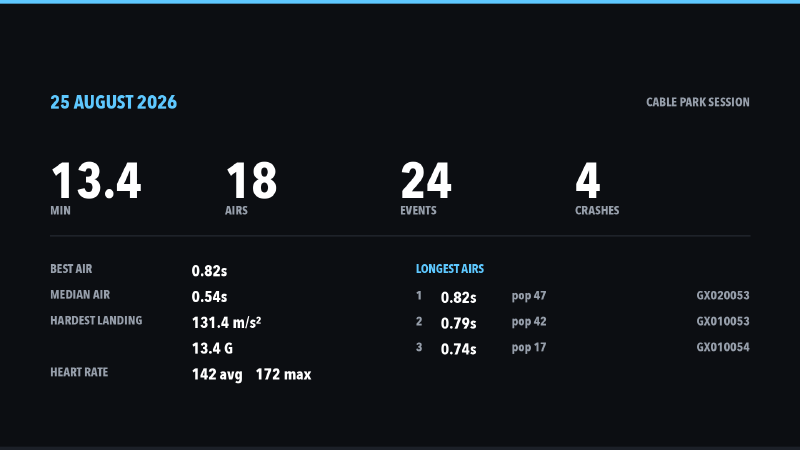
What I’ve ended up with is a file of my own verdicts on specific moments — this one was a crash, this one I landed and then let go of the handle — which the test suite now checks any change against. It’s at six right, one wrong and one honestly unsure out of eight. The one it gets wrong is a good landing that I rode away from and then coasted to the dock, which looks identical to a crash if all you have is speed, and I don’t think any amount of cleverness fixes that one.
The other experiment has been chopping the biggest airs and hardest crashes across several sessions into a vertical thing for YouTube Shorts. The first one did 806 views over about a week. The second one — which deliberately used only footage nobody had seen rather than rebuilding a “best of everything” that would have been sixty percent repeats — did 1.1k in its first day.
One data point each, so I’m not drawing any grand conclusions. But it does suggest that a minute of someone hitting water at 12G travels rather further than eight hundred words about smoothing windows.
Still haven’t ridden the pipe.