
So between 1983 and 1996 my dad kept a typed diary of every official overseas trip he supported for the UK government, travelling with the Prime Minister — Thatcher, then Major — or the Foreign Secretary (Howe, Major briefly, Hurd for years and years, then Rifkind), plus the occasional outing with the Chancellor. One page per year, a neat table of trips, his own typed totals at the bottom of each one, and a running total since 1983 underneath that. It’s the sort of document you grow up vaguely knowing exists, and then one day you actually sit down with the scanned pages and realise what you’re looking at, which in this case is fourteen years of history typed up one trip at a time by someone who was actually on the plane.
The numbers, once you add them up properly, are a bit silly. 387 trips. 1,438,746 miles — six times the distance to the Moon, or 12,297 laps of the M25, or 1,439 times the distance The Proclaimers were prepared to walk, depending on which comparison the app feels like showing you when it loads (there are forty of them, it picks one at random, and I regret nothing). 1,444 days away, which is very nearly four of the fourteen years. Ninety-eight countries as they’re drawn today, quite a few of which didn’t exist under that name when he landed in them — the diary says U.S.S.R., Peking and Bombay, because that’s what the world was called at the time, and the transcription keeps every word of it.
That was the first rule of the project, and the one everything else hangs off: record what’s typed. Every trip is transcribed exactly as Dad typed it, typos included, with corrections stored alongside rather than over the top. The second rule is that Dad’s own totals are never “corrected”. Where his year-end arithmetic disagrees with the transcribed rows, the difference is shown, not silently fixed. And here’s the thing — across fourteen years of adding up mileages by hand from airline schedules, there are precisely two discrepancies: one year where he subtracted a 7,014-mile trip instead of adding it, one year that’s out by 43 miles for reasons lost to history, and a single off-by-one in his running trip count. That’s it. I’ve written software with worse arithmetic than that, some of it this month.
Being me, I couldn’t just transcribe it into a spreadsheet and leave it alone. The whole thing is generated from one Python file — every trip, every stop, every refuel — which builds both the spreadsheet and the data behind the app, and refuses to build at all if a single figure drifts from the known totals. There’s a great-circle check too: straight-line distance from Heathrow through every stop and back, which his recorded mileages track to within a few percent on average. The trips that run well over the straight line turn out to have good reasons — the Bosnia trips fly 30 to 60 percent long because you couldn’t exactly fly direct into Sarajevo in 1994, and the short French hops are inflated because he scrupulously counted the car miles too. Not one trip in 387 comes in suspiciously under the straight-line distance, which is the direction that would suggest a missing stop. The man was reliable.
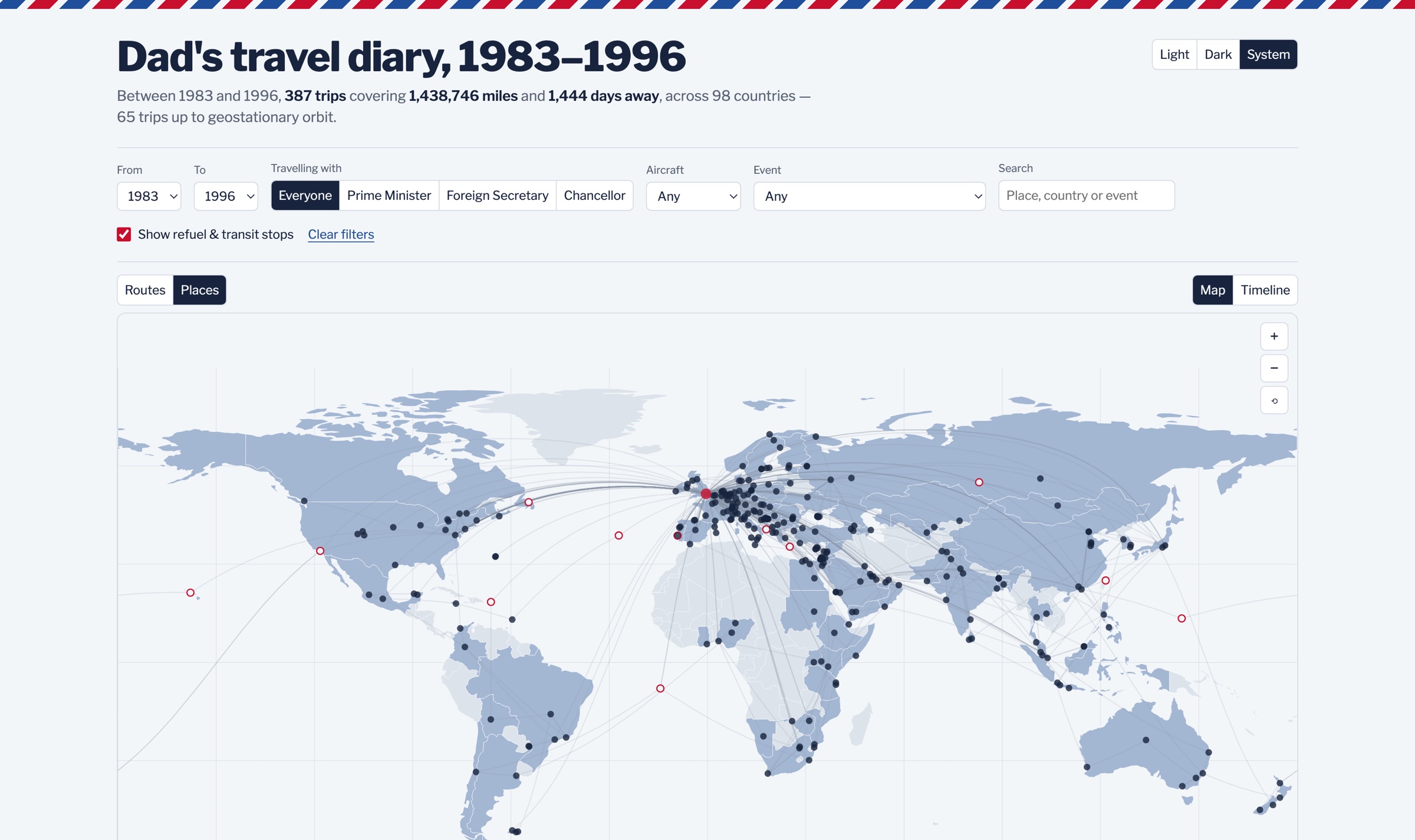
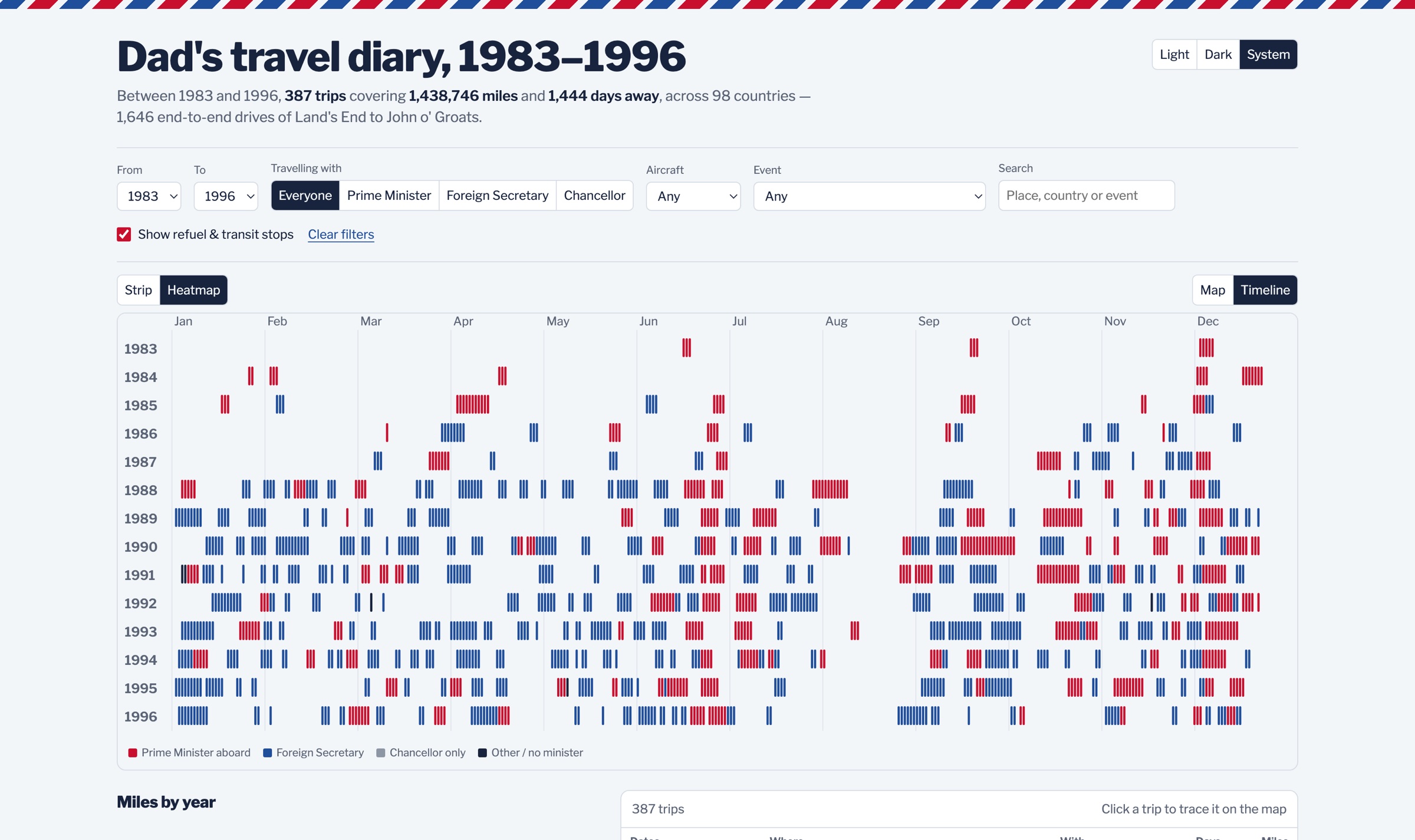
The app itself is a single page with a world map of every route out of London, dots for everywhere he stopped, and hollow ones for the refuelling stops — Bahrain nine times, more than anywhere else, which tells you a lot about the range of a VC10. There’s a Places mode that shades in every country visited, a timeline you can flip between trip-strips and a day-by-day heatmap coloured by who was aboard — red for the Prime Minister, blue for the Foreign Secretary — and the heatmap view of the early nineties is honestly a bit alarming, whole months where the away days outnumber the home ones. You can filter by minister, aircraft or event, and click any trip for the full story: every stop with the dates exactly as typed, the mileage by aircraft, and a “Diary says” line preserving Dad’s original wording. Douglas Hurd comes out as the clear champion at 207 trips and 762 days.
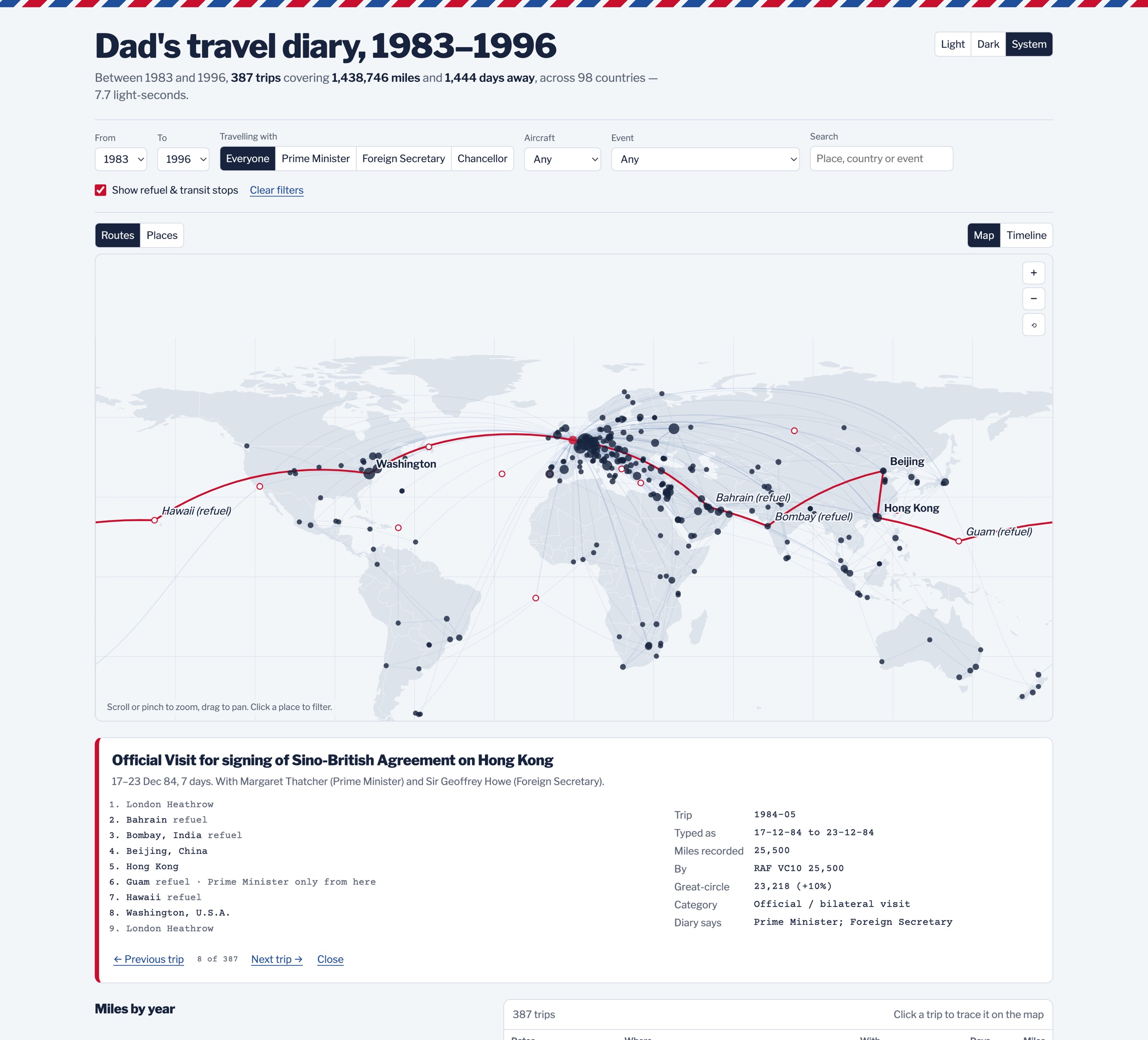
My favourite single entry is December 1984: London to Beijing for the signing of the Sino-British agreement on Hong Kong, refuelling in Bahrain and Bombay on the way out, then home the long way — Hong Kong, Guam, Hawaii, Washington — 25,500 miles around the planet in an RAF VC10 in seven days, with a typed note that the Prime Minister was only aboard from Guam. There are two trips with no minister at all, reconnaissance visits, which Dad — scrupulous to the end — did not count in his own totals. The diary also records, without comment, quite a lot of history: Moscow three weeks after the Gulf War ceasefire, the shuttle diplomacy around former Yugoslavia, summit after summit after summit.
Fair warning for anyone who read the last post: having ended the Lagoon write-up with “a stubborn refusal to install React”, I have to confess this one is React. In my defence it started life as a working prototype and the port kept the prototype honest, but I accept the hypocrisy and will be hearing about it from myself for some time. It deploys to the same S3-and-CloudFront setup as this site, behind a small function at the edge that asks for the password before serving so much as a byte of the data — which had one consequence I should own up to: the first time this website deployed itself after the app went live, its sync helpfully deleted the app, because nobody had told the pipeline about the new tenant. The family got a 404, I got a lesson in shared infrastructure, and the deploy script got an exclusion.
The build itself was a collaboration with Claude Code, and a fairly industrial one — a written spec, a written plan, and thirteen tasks each implemented and reviewed by separate agents, with a whole-branch review at the end and every one of Dad’s totals pinned in the tests as a tripwire. At one point the session building the app was messaging the session that runs this website to negotiate the password protection between themselves, which I’m choosing to find delightful rather than unsettling. The whole thing, from a folder of scans and a very good CLAUDE.md to the app being live, took a weekend of evenings and a lot of “can we also…”, which is the best kind of project.
Next up: there’s a “link each trip to the scanned diary page” feature that needs someone to leaf through four PDFs and build a page mapping, and a couple of genuine open questions in the data — a trip recorded only as “Foreign Minister”, and a Falklands flight that almost certainly refuelled at Ascension but doesn’t say so — that want checking against the originals before anything gets changed. The rule for those is the same as ever: the diary says what the diary says, until the scans say otherwise.