
I used to work at Amazon. I know how the Leadership Principles work, I know what “Customer Obsession” means when it’s written on the wall of every meeting room, and I know what “Bias for Action” looks like when it’s functioning properly. I mention this because over the past three months I’ve had a front-row seat to what happens when neither of those things is functioning at all, and the contrast has been — educational.
In late August I ordered a GoPro HERO13 Black from Amazon UK. £289.26. The parcel arrived with a one-time delivery code, which I gave to the courier, which means the chain of custody is about as clean as it gets. I opened the box and found a bottle of baby oil. Not a GoPro with a complimentary bottle of baby oil. Not a GoPro in unusual packaging. Just baby oil, weighing about the same as a boxed action camera, which I imagine is not a coincidence.
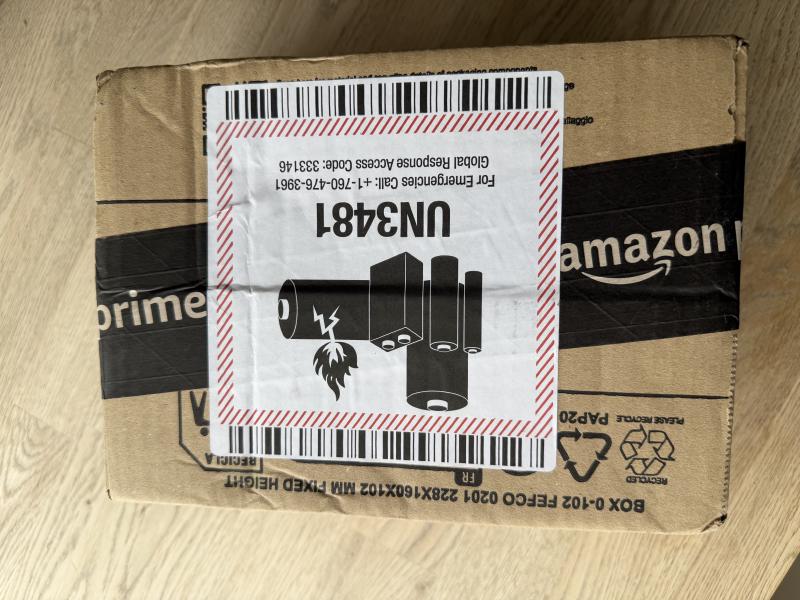
Somewhere between the warehouse and my front door, someone swapped a £289 camera for a bottle of baby oil and resealed the package. The box even had a UN3481 lithium battery hazard sticker on it — for the GoPro battery that wasn’t inside. That’s either a spectacular picking error or something rather more deliberate, but either way it’s Amazon’s problem, not mine.
Contact one: late August#
I reported it through the app. The chatbot handed me to an associate who took a remarkably long time to grasp the situation, cycling through “please do not worry, I will sort this” and offering a UPS collection on a loop. At one point I asked whether there was an adult in the room. They assured me they were human, and I told them that in that case I was worried about their wellbeing. There was a brief aside about the British weather — “Raining today, so maybe the end of summer” — which, while charming, didn’t get me any closer to a GoPro.
Eventually: UPS collection arranged, baby oil returned in its original packaging, full refund to my card. Refund confirmed on the 9th of September. Done, I thought.
Contact two: 15 October#
An email arrived saying the GoPro hadn’t been returned. This was technically accurate in the same way that saying I hadn’t returned a trombone would be technically accurate — I never had one. I’d returned the thing Amazon actually sent me.
The associate told me it was “an automated email triggered by an error”. I wouldn’t be charged. I should ignore it. It had been “fixed” and flagged to the returns department. I was gracious about it — mistakes happen, and having worked at Amazon I totally get how these things can slip through. Customer Obsession, after all, starts with trust.
Contact three: 3 November#
The chatbot labelled it an “unreturned item” again. I asked for a phone call. The chat ended without one. Four minutes later I tried again and got a different associate who “disabled notifications about this return” and stated, clearly and more than once, that I would not be charged. I asked whether the chat would be linked to the order so I wouldn’t have to explain the whole story again next time. I didn’t get a clear answer.
That’s three contacts, three people telling me it was sorted. At this point I had more documented promises than a government manifesto.
Contact four: 8 November#
Amazon tried the £289.26 charge again. I’d been deliberately keeping my bank balance low so the charge would bounce, which is not a normal thing to have to do with your own bank account because the world’s largest retailer keeps trying to take money its own staff have agreed it shouldn’t.
Three associates in one evening. The first confirmed the September refund and transferred me. The second said the charge couldn’t be stopped and could only be refunded after it had gone through. I asked to be transferred — “or at least pretend you are transferring me to someone who can, even if they can’t, as then I become their problem and not yours.” They escalated me to a supervisor.
The supervisor explained that the returns centre had reported receiving “an entirely different item” — yes, that’s what I told you in August — and that the charge happened because “the return reason code was not correctly selected”, which was Amazon’s error, not mine. The charge, she said, “must be retrocharged so we can fix it.” Let it go through, and it would be refunded.
She described herself as “the highest point of escalation.”
I replied: “Jeff?”
She closed the chat.
Contact five: 13 November#
On the strength of a supervisor’s explicit instruction, I let the charge go through. Amazon took £289.26 from my account. At this point I have no GoPro, I’m £289.26 down, and I possess a truly impressive archive of chat transcripts in which five different people have promised this would be sorted out.
The chatbot’s summary for this contact helpfully noted that I had “already received a replacement.” I had not received a replacement. The GoPro that arrived two days after the original order was a separate order that I paid for. The system was now inventing history.
Two more associates. The second one told me the refund now required an Incident Report form, to be emailed after the chat, with a deadline of the 19th of January 2027. This was the first time in five contacts and three months that anyone had mentioned a form. I asked for a manager. I was told a manager would give the same answer. I asked why, across four previous contacts and two months of being told this was fixed, nobody had offered the form before the money was taken. The answer was unclear.
When the chat ended, the form still hadn’t arrived. My last message: “How can you confirm if I’ve received the form or not?”
I reminded them that Amazon’s own Leadership Principles talk about it always being Day 1. This, I said, felt a lot like Day 2.
The tally#
- 5 contacts, roughly 9 associates, plus chatbots
- 3 explicit promises that I would not be charged
- 1 charge taken: £289.26
- 1 refund outstanding, pending a form that hadn’t arrived when the chat ended
- 0 GoPros received at any point in this process
What I’ve learned#
Screenshot every chat before you close it. Amazon’s chat history is not reliably complete, and the next associate will start from zero regardless of what the last one promised.
Get “you won’t be charged” in writing. The chat transcript counts, and under UK consumer law that’s a representation you can hold them to.
A card chargeback is the backstop. If the form doesn’t resolve this, my bank can dispute the charge directly. Amazon sent the wrong item, Amazon’s own staff confirmed it multiple times, and I returned what I received through the process they arranged.
What baffles me isn’t that Amazon sent the wrong item — that happens at scale and the initial process worked fine. It’s that once the return was flagged as mismatched, the only path through the system was to charge me and then undo it, rather than looking at the five previous contacts where their own people confirmed it was their mistake. Every associate could see the history. Every one of them agreed it was wrong. None of them could stop it. The humans were willing; the system was not.
Somewhere in all of this, Customer Obsession became Customer Patience, and Bias for Action became Bias for Process. I’d love to know which mechanism decided that was acceptable.
Update: 13 Nov 2026 — Incident Report form received and returned. Awaiting refund. I’ll update this post when it’s resolved.